Wish You Could Parent With A Clean Slate? You can!

I became a grandma today!  And the flood of hopes and dreams for my kids came rushing through my mind.  And it dawned on me that my son now has his hopes and dreams for his son–a clean slate with which to start.

But let’s face it, sometimes by the time our kids become tweens and teens we wonder if those hopes and dreams are even real any more.  They frustrate us and do things that we cannot fully comprehend.  We wonder if their decisions are tied to the way we parented or if they are just part of their immature brains.  And what do we do?

We do what most normal moms do — we react, we nag, and we try to teach.

And sometimes they put up walls. 

And even though we try to explain, to encourage, or help them see another perspective, they continue to fortify the walls or begin reacting to everything we say or do.  Sometimes we find ourselves in a no-win situation.

The phrase in our house became “Can’t we all just get along?“

Several years ago I was in that no-win situation.  One of my kids had put up the walls.  Anger and bitterness seemed to rage at times.  She could only see her perspective and as a mom I could do nothing right in her eyes.  Sometimes I would choose to be silent rather than pursue what I knew would be a battle.  

Honestly, when she was in our home I didn’t have the skills to turn our relationship around.  My husband, Dave, and I even went to counseling trying to learn how to repair the relationship and hopefully start tearing the walls down.   And we were taught some skills–skills to deflate defensiveness and resolve conflict.  We worked hard on the relationship with our daughter even though by that time she had turned 18 and moved out.  I continued to do research and practiced what I was learning with all my kids.  I did everything in my power to seek her out and try to connect as she would allow.

And then I met a fellow trainer, Nina Roesner, who was working on strengthening her marriage.  And we would talk for hours about the skills that most of us weren’t taught growing up.  She was doing research too and the more we talked and struggled through our own family relationships, the more we learned about what worked and what didn’t.  We started reading all the brain research and putting the pieces together in what has become an unbelievably eye-opening course.  Last year Nina piloted the course for the first time.  (She is an amazing curriculum writer!).   And just like all our training materials, lives are changing in amazing ways.  God shows up and something happens over, and over, and over.

Parent/Child relationships have been strengthened and reunited.

Marriages have been restored.

And walls have come tumbling down.

About a year ago, my daughter told Dave that I was her best friend.  She said she could tell me anything and I would listen and “hear” her.  She now felt understood.

It’s a skill I needed to develop.  It gave me a clean slate in my parenting helping me forge the relationship.

Now it’s a skill that you can develop too.  And it’s training that we only do once a year.  You’ll get to practice the skills Nina and I have both learned in a safe environment.  People have told us it is amazing!


But here’s why it is so important that you learn these skills.  

Our kids are taking notes.  They’re learning from us! 

Will they learn to deflate defensiveness and resolve conflict well by watching you?

Just the other day I was having a somewhat heated debate with one of my adult sons.  I wanted him to understand my perspective, but we weren’t getting anywhere.  (And, yes, I’m human and forget to use the skills sometimes.)  Anyway, it dawned on me that I needed to change the way I was approaching the conversation.  As I did, suddenly, my son stopped the conversation and said, “Mom, you’re getting good at your deflating defensiveness skills!”  

He noticed! 

We laughed. 

And now I know that as he learns from me, he’ll be able to carry those skills into his parenting with our new grandson!

That’s a win-win situation.

We hope you will join Nina and me this year to learn the skills to help deepen your relationships.  

Proverbs 25:11 NET

Like apples of gold in settings of silver, so is a word skillfully spoken. 

Dare you to pray about joining us!  We hope you’ll take advantage of the discount that is good through December 31, 2017.  You’ll be joining women from across the country who want to improve their relationships and develop the skills that can be passed down for generations to come. 

Please know that since we are in a beautiful retreat setting (with your own private room), space is limited.

You can click here for more information.

Learning to…

“Let go…and Let God”,


Emotions Out of Control? 5-Steps to Reset the Relationship

Emotional outbursts can be spurred in most of us.  We find ourselves yelling at our kids when our space has been upset.  The same is true of our teens.  They come home from school livid at something that happened and instead of dealing with the situation, they stalk through the kitchen screaming at us and what we’ve done that has ruined their lives.

I’ve been doing research for several years about our emotions and how they affect us as well as our kids.  One of my kids has always been hypersensitive emotionally and the smallest thing could bring a mountain of inconsolable tears, or anger, or even full-on rage with a sibling being the targeted opponent.  As a mom who hadn’t been taught to understand my own emotions, I was helpless to understand my child’s.  Trial and error brought nothing but further anguish and louder communication (okay, yelling!) on both our parts.

What I’ve since discovered is that there is a small part of the brain called the amygdala that never lets us forget.  It houses the emotional control center where the fight or flight response occurs.  Everything we encounter runs through that emotional part of our brain before we can discern if it has a valid reason to respond.  That center tells us if something is good, bad, or terrifying.  If that part of the brain is triggered before we have time to give the situation cognitive thought, we will react rather than respond appropriately in a given situation.  Years later, if we encounter a situation that brings about a similar fear or feeling, we will again react without thought.  It is ingrained and “remembers” the feeling and causes us to respond accordingly even when we don’t understand why we did what we did.

New research that is out  talks about the brain skills that many of us as parents haven’t learned.  When we have emotional outbursts we need to pause so we can:

  1. Recognize the emotion
  2. Understand what our reaction is attached to from the past
  3. Identify what expectation we are holding onto that might solicit the out-of control response
  4. Transfer the emotion through our cognitive thought in order to form a better response
  5. Re-engage with an apology to re-set the relationship

Instead many of us keep doing what we’ve always done in similar situations as we emotionally erupt or we see many kids and adults alike resort to drugs and alcohol use to dull the pain within.

How can we teach our kids to establish emotional control when at times we don’t have the capacity to display what it should look like?  If we were never taught these skills how can we pass them on to the next generations?

Life Model Works has a book out entitled Transforming Fellowship: 19 Brain Skills That Build Joyful Community  to raise awareness of how emotional skills can transform relationships.  While their book is focused on building community within the church, so many of the principles apply to us with our kids.

Scripture also gives us a clue:

Romans 12:2

Do not be conformed to this world, but be transformed by the renewal of your mind, that by testing you may discern what is the will of God, what is good and acceptable and perfect.

Philippians 4:8

Finally, brothers, whatever is true, whatever is honorable, whatever is just, whatever is pure, whatever is lovely, whatever is commendable, if there is any excellence, if there is anything worthy of praise, think about these things.

2 Corinthians 10:4-5

For the weapons of our warfare are not of the flesh but have divine power to destroy strongholds. We destroy arguments and every lofty opinion raised against the knowledge of God, and take every thought captive to obey Christ,

Choosing to focus on the good even in painful or difficult situations can help us re-wire our brain and our emotional capacity.  Learning to pause long enough to analyze the patterns or getting help from professionals can also help us gain control over our emotions.  And when we are in relationship with others who struggle with emotional control it is important that we learn to take care of ourselves.

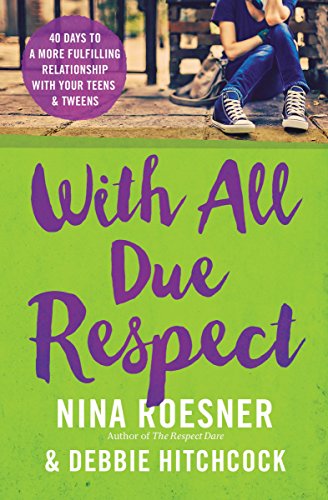
If you have kids that are struggling with emotional outbursts, With All Due Respect: 40 Days to a More Fulfilling Relationship with Your Teens and Tweens is a good place to start.  In it you’ll find ways to interact with your kids and help them see healthy coping skills.  If you have kids that are further down the path and are already into drug or alcohol addiction, I’ve discovered a new book that will help you get your life back.  In her book You Are Not Alone: Hope for Hurting Parents of Troubled Kids Dena Yohe shares her story and practical tips for parents who are  dealing with teens and 20-somethings who are on a destructive path.  You can listen to her interview on Focus on the Family, Monday and Tuesday, August 21-22, 2017.

Praying that God will raise your emotional awareness as you parent this next generation.

“Let go…and Let God”,

Interested in leading a parenting Bible study that will have women talking and learning about emotional maturity?  Want them to walk away with a WOW! experience?  With All Due Respect will do just that and we promise to make it easy to lead.  You don’t need to be a perfect parent; you don’t need to have perfect kids; and you don’t need to have ever led a group before.

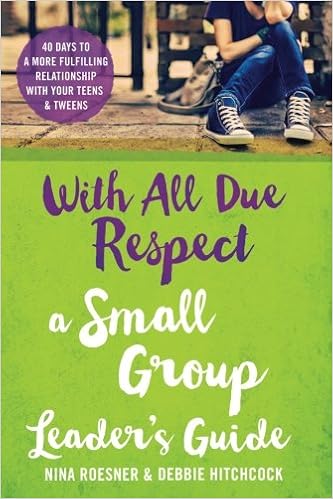
For the next month we’re offering our new Small Group Leader’s Guide for only $5.95 so you can get your small group started right away.  That means you can start a group at a greatly discounted rate!

Our Small Group Leader’s Guide is an easy-to-follow guide that will give you questions, exercises, and opportunities to engage with other parents as you think about your own parenting.  If you know a mom who has kids that are 9 or 29 this study will be life-changing as they think about parenting.  You can even get suggestions on how to run your groups from me.  I love to engage with other moms and leaders and you can reach me through the website at www.greaterimpact.org. 

 So grab your friends, and grab a copy of the Small Group Leader’s Guide here .

Dare ya!

With All Due Respect: 40 Days to a More Fulfilling Relationship with Your Teens and Tweens by [Roesner, Nina, Hitchcock, Debbie]


Is it Time for a Reset in Your Parenting?

I don’t know about you, but I seem to do my best parenting after the fact.  Maybe you can relate; so let me explain.  

  • I give my kid freedom he isn’t ready for it and then I don’t know how to take the freedom away without a fight.
  • I don’t think about the potential consequences of a given situation because I don’t know what I don’t know, and then my ‘yes’ in that circumstance equates to a ‘yes’ in the next situation in my child’s mind resulting in conflict.
  • The consequence I issue brings more grief and frustration to me because all I get is whining and push back from my teen.
  • Sometimes the consequences for my child put me in a situation of having to always monitor making me a slave to the consequence I created.
  • My teen has a way of manipulating things in a way that force me to say ‘yes’ when I should be saying ‘no’.
  • I enforce a family rule just because one kid needs it and it is easier to deal with everyone rather than just dealing with this particular kid’s issue.
  • My kid breaks so many rules where I have to issue consequences that my child will be grounded until they are 25.

If you are like me, sometimes when the conflict gets to be too much and the heat is on, it is easier to disband with the consequence or not worry about the potential negative outcome of a behavior because parenting just becomes too difficult.  Sometimes our main focus in the weariness of it all becomes peace — and peace can be achieved if we choose to look away.

But is peace always a good thing?  If our kids are out doing their own thing and we are doing ours, there may be peace but is there relationship?  It may be easier, but who will they become?  What will be their moral foundation?

I want to encourage you not to take the easy way out.  Parenting is hard, parenting is messy, and sometimes parenting needs a reset.  

What are your parenting goals?  Kids with good behavior?  Kids who can think in tough situations?  Kids with a moral compass?  Kids who love God and others?  Kids who can succeed at life?  Kids who will want to have a relationship with their parents when they are adults?  Kids who won’t have a lot of baggage to carry into adulthood?

The reason I ask you about your goals is so you can focus on the majors.  You know, those areas that will really impact our kids’ future. Putting all our energy in making sure we correct every little issue we see in our kids’ behavior will create more conflict than we can possibly handle.

In other words, as parents we can’t close our eyes to things our kids need to learn but we also shouldn’t focus on all the issues we see from our kid.  Our lives are a journey.  They can’t learn everything at one time or they’ll be discouraged and give up.  

So how do we handle things when we’ve created a situation where our current consequences are creating more problems?  This is  a time when you my need a reset.

Ask yourself:

  1. How important is it that this kid needs to learn this lesson?  
  2. Will it impact his future as an adult?
  3. Is there need for a reset? 
  4. What exactly is the problem?
  5. Is this consequence creating more conflict in our home?
  6. Are the consequences escalating such that my kid keeps getting into more and more trouble?

Instigating a reset with our kids always starts with an apology.  This is where you admit that you don’t always get it right in parenting.  Let your child know where you messed up and ask for their forgiveness.  Let them know you are on the same team–you both want the same thing–their freedom.

Let your teen know that changing or resetting the consequence means the goal is the same — to help them become better adults.  Freedom and adulthood go hand in hand.  Learning consequences in the structure of your home will be a lot easier than learning them in real life situations out in the real world. 

Remember that parenting isn’t a battleground (I win/you lose/you will do what I say or else).  It is a place where both of you are working toward the same goal–a partnership to freedom.  It is important to remember that as parents we do have authority over our children, however, if we can establish a win/win mentality then conflict will decrease as a result of the partnership.  We need to major in the majors and let the little things slide that don’t necessarily have significance.  We need to see our job as parents is to put wind under our children’s wings along with giving them opportunity to fail.  Parenting with wanting to control the little things will increase conflict and negate the partnership.

Institute the new consequence.  After apologizing, explaining the reason for the reset, and establishing the partnership with your teen, be sure to issue the new consequence.  Our teens need to see that we have their best interest at heart.  We want them to be mature adults who understand consequences of wrongful actions.  Forgetting about the infraction or letting them off the hook doesn’t right the wrong and won’t allow them to learn the lesson you are trying to teach.  

Parenting is full of do-overs.  After all, parenting is a growth process as well.  Take the time to do a reset as many times as is necessary.

2 Chronicles 1:10

Give me wisdom and knowledge so that I may lead these people.

Whether we realize it or not, as parents, wisdom comes from our mistakes, from God, and from watching other people get it right.  It isn’t an easy road.  But if we will humble ourselves God will be faithful to complete the work in us and our children.

“Let go…and let God”,

Interested in leading a parenting Bible study that will have women sharing on a deep level from the beginning?  Want them to walk away with a WOW! experience?  With All Due Respect will do just that and we promise to make it easy to lead.  You don’t need to be a perfect parent; you don’t need to have perfect kids; and you don’t need to have ever led a group before.

 In honor of Parent’s Day, the publisher is featuring a Kindle Version of the book for only $0.99 through July 25.

In addition, for the next month we’re offering our new Small Group Leader’s Guide for only $5.95 so you can get your small group started right away.  That means you can start a group at an almost 80 percent discount!

Our Small Group Leader’s Guide is an easy-to-follow guide that will give you questions, exercises, and opportunities to engage with other parents as you think about your own parenting.  If you know a mom who has kids that are 9 or 29 this study will be life-changing as they think about parenting.  You can even get suggestions on how to run your groups from me.  I love to engage with other moms and leaders and you can reach me through the website at www.greaterimpact.org. 

 So grab your friends, and grab a copy of the Small Group Leader’s Guide here along with your eBook copy of With All Due Respect.

Dare ya!

With All Due Respect: 40 Days to a More Fulfilling Relationship with Your Teens and Tweens by [Roesner, Nina, Hitchcock, Debbie]


How Do You Want to be Remembered as a Parent?

This has been a contemplative time for me as a parent.  Dealing with my own daughter’s death and thinking through her life, God has brought to mind many of my parenting interactions — the good, the bad, and the ugly.  There are many of those thoughts where I got it right in my parenting interactions, yet there are other times where I wish I could have had a “do-over”.  Grieving is hard work as it takes me down memory lane.

It occurred to me that the process of grief makes us look backward — what was, but could have been different.

As I contemplate that thought I’ve been reminded of my years as a corporate human resource manager.  Every year employees were asked to set goals for personal growth.  Each person was to write down not only what they wanted to achieve in sales, technical expertise, and other things to accomplish for the year, but they were also asked to assess what would make them more valuable in their job as a person.  These were what were sometimes seen as soft skills.  Leadership, influence, communication, and personal awareness were identified as opportunities for improvement.

As I compare the business world to family life, I wonder how many of us as parents take the time to set goals for ourselves — specifically in the soft skills.  As moms we sometimes set goals for running our homes such as making sure the kitchen is clean before we go to bed or cleaning the toilets at least once a week, but do we think about setting goals for how we interact with our kids?  Do we envision the person we truly want to be?

Thinking about our role as a parent is two-fold — yes, we need to think about the skills and goals for our children so they can become successful adults, but we also need to also think about the legacy of relationship that we will pass on to the next generation.

As we look forward to who we want to be or what we want to accomplish, it is sometimes easier to fast forward to a time in the future.  I’m going to ask you to look at who you are as a parent and consider what you would like your children to write for your eulogy.  What words do you want on your tombstone?  How do you want to be remembered?

  • She was a good listener.
  • I could tell Mom anything without condemnation or reaction.
  • Mom was gentle.
  • She was fair in serving consequences.
  • There was never a doubt that she loved me.
  • I knew I could always count on her.
  • She was calm and never raised her voice.
  • Mom didn’t stand over me always telling me what to do.
  • Mom let me make mistakes and taught me how to resolve them.
  • She asked me if she could share her thoughts when she knew I was about to make a poor decision.
  • Mom didn’t bail me out when I messed up.
  • She let me own what was mine to own.
  • Her laughter filled out home.
  • She was great at encouraging me.
  • She loved God and wanted me to know Him like she did.
  • Her words and actions were in sync.  I always knew where she stood on any subject.
  • I could always count on her to be there to support me.
  • She taught me to keep my commitments.
  • When mom made a mistake, she always apologized.
  • Mom worked on her own personal growth and encouraged me to do the same.
  • Even though Mom had lots to do, she would always stop whatever she was doing to focus on what I needed from her.
  • She always validated my feelings letting me know she truly understood.
  • Grace was more important to her than coming up with another rule that I would have to follow.

How did you stack up?

If there are things on this list or even your own list where you feel like you might be falling short, I would encourage you to take time to contemplate and set goals for personal growth.  While none of us is a perfect parent, if our kids are still alive we have opportunity for a “do-over”.   We have time to override what our future holds as we overlay our new behaviors on our old self.

Ephesians 4:22-24

 You were taught, with regard to your former way of life, to put off your old self, which is being corrupted by its deceitful desires;  to be made new in the attitude of your minds; and to put on the new self, created to be like God in true righteousness and holiness

If you remember a situation that you didn’t handle appropriately yesterday, last week, last month, or a decade ago — go back and apologize.

If you keep adding rules for your teens to follow rather than offering grace and connection — tell your kids that you’ve decided to dispense with some of the rules because you’ve seen progress in their behavior and want to give them more freedom.

If you find yourself raising your voice to the level of your kids’ outbursts — pause and speak with a gentle, controlled voice or let your children know that you will talk about the situation later when your emotions are under control.

Ask God to help you see and grieve your parenting mistakes from the past so that you can press on to be the parent He desires you to be for the future.

What changes need to be made in you as you move forward in becoming the parent God wants you to be?  What is one small step you can start making toward a better eulogy from your kids?

Dare you  to post one thing that you are going to work on as you parent.  Just by posting you are interjecting a level of accountability in making the change.  Then be intentional in asking God to help you reach that goal.

Praying God will infuse your heart and mind with the goodness of His grace.

“Let go…and Let God”,

If you want to have influence in your family and desire to become a Titus 2 Woman leading other’s to grow in their walk with God, we have an opportunity to you.  Our Titus 2 Boot Camp will give you opportunity to learn the skills that will transform your life into one that honors Him.  We give you the tools as well as an opportunity to practice them in a safe environment.  It’s fun!  It’s a growth opportunity in the soft skills I mention in this post. And, it will be a time of refreshment as you spend time with God in a beautiful retreat setting.  Meet other women who love the Lord and want to serve Him in their marriages, in their families, and in whatever He calls them to do.  You’ll have time to interact with both Nina Roesner and Debbie Hitchcock personally as we lead you in an exciting weekend of personal growth.  If God is calling you, we hope you will join us!  If you can gather a group to attend, contact us for a discount.  We promise, it will be a growth opportunity like you’ve never experienced before.


It’s Never Too Late to Right the Wrongs

This past week something transpired in our home that helped me realize how our words and actions can have devastating impact on our kids for years to come.  Keep in mind I have four kids who have grown up under our roof who are now 20-Somethings.

Most people would have described us as a loving Christian family who were very involved in our kids’ lives.  If you look at our family today, you’d probably say the same thing.  Our kids visit often and it is obvious that we have deep connection.

But last week — those great parenting feelings morphed into a “what was I thinking” moment.

Hang with me here because this is really important as our tweens and teens get older.  They will get under our skin.  They will do things that will set us off.  And we will hear things that will send us spiraling into a moment of fear and that’s when we will react.

Our daughter shared a memory with me about how her dad had “come unglued” at something he thought her younger brother had done.   As she was recalling the memory almost 10 years later, I could visibly see the emotion and accusation in her voice.  The anger and resentment was as if the event had just happened–and the event didn’t even happen to her–it was her brother.

You need to understand that this one event was not my husband’s typical response to our kids.  He’s one of the most engaged dads on the planet and he tends to be the peacemaker in the family so this was an out-of-the-box rare moment for him as the kids were growing up.  I’m guessing that this is why the memory was so overwhelming to our daughter.  It didn’t fit with how she viewed her dad.

Seeing how upset she was at the memory, I did the only thing I knew to do–I apologized for my husband’s behavior from a decade ago.  I told her that it must have seemed scary to her.  And I told her I was sorry that I had not tried to diffuse the situation at the time.  And then I admitted that my husband and I had not been perfect parents and that I hoped she would forgive us for what happened.

And it was amazing to watch the transformation in our daughter.  A sense of calm seemed to come over her.  It was as if the wrong had now been righted as she viewed the story through her now adult eyes.

Having seen how the event triggered in her, I was curious as to whether or not her younger brother remembered the incident–after all, it had happened to him.  Sitting on the back patio I described the conversation with his sister.  Within seconds the emotion exploded within him.  Yes, he had forgotten the situation all those years ago, but when reminded of the story, his anger returned full force.  “Mom, I swear I didn’t do what he accused me of!  Why did he do that?”

For the second time, I needed to apologize for my husband’s behavior 10 years ago.  I admitted the injustice in the situation.  I assured him I didn’t know what had come over his dad in the moment.  I reminded him that one event doesn’t define a man. And I made sure that he recognized that his dad and I loved him dearly.

But the conversations didn’t stop there.

That evening I asked Dave if he recalled the incident and I suggested that he needed to apologize to both kids.  Always true to his word, I came home yesterday afternoon to hear him seeking forgiveness from our son for his reaction 10 years ago.  The reconciliation between the two was heartfelt.  The wound that I had discovered by bringing up the subject would now have a chance to properly heal.

As parents we will make mistakes and some of those mistakes will be carried into the future for our kids even though for us they have been long forgotten.

But we have a God who encourages us to reconcile and right our wrongs.

Matthew 5:23-24

“Therefore if you are presenting your offering at the altar, and there remember that your brother has something against you, leave your offering there before the altar and go; first be reconciled to your brother, and then come and present your offering.

As parents we have opportunity to apologize and bring healing to those emotional triggers for our kids if we will choose to walk into the conversations providing an opportunity for them to spew their emotion and us to offer a genuine apology.

James 5:16

Therefore confess your sins to each other and pray for each other so that you may be healed. The prayer of a righteous person is powerful and effective.

Dare you to walk into the conversation of apology when your kids bring up painful memories of the past.  Stand in the gap for your spouse or someone else to bring healing to their emotional wounds so your kids will be better equipped to mature in healthy ways.

“Let go…and let God”,

Did you know that we’ve started a new Facebook eCourse just for Moms of tweens and teens?  I hope you will join me there.  It is an opportunity to get practical parenting advice and interact with other moms.  We’ll go through With All Due Respect together as we encourage you, pray with you, share successes, and hardships.  You’ll create relationship with other moms including those who are at least 10 years ahead of you in the parenting process.  And right now it is 50% off as we transition to the new platform.  Dare you to join us!